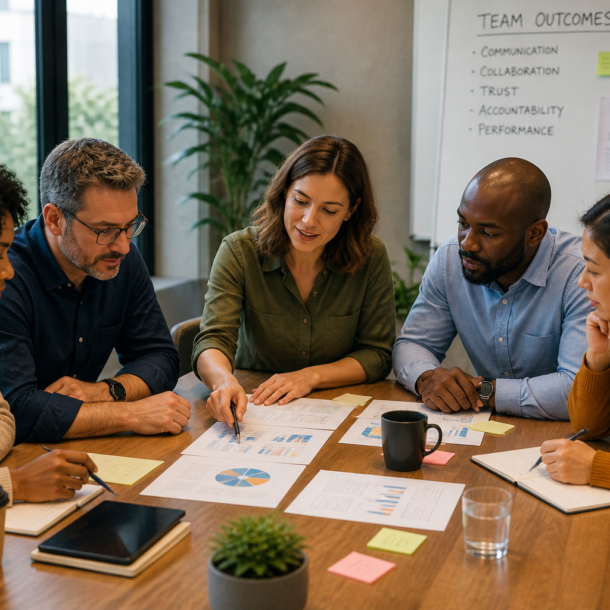

Team building in the workplace does not always require a venue, a full day away from the office, or elaborate activities. In many cases, the most effective sessions are those that take place within the work environment itself.
Office-based team building offers a practical solution for organisations that want to improve teamwork without disrupting operations. It reduces logistical complexity, lowers costs, and allows teams to focus on real workplace challenges as they happen.
However, there is a common misconception that office-based sessions are less engaging or less effective. This often comes from past experiences where sessions felt rushed, unstructured, or disconnected from actual work. When this happens, team building becomes something teams tolerate rather than value.
When designed correctly, office-based sessions can be just as impactful as off-site experiences. In many cases, they are even more effective because they are directly connected to how teams operate on a daily basis.
The key lies in how they are structured. Team building work should always be guided by clear objectives, not just activities. Without this, even the most creative team building games for the office will feel disconnected from daily work and fail to create lasting change, which is why clearly defined team building objectives play such an important role.
Share what’s showing up—low trust, poor accountability, conflict, tension, burnout-driven irritability, or lack of clarity—and we’ll recommend the right intervention.
Many organisations attempt to run team building exercises for staff internally but struggle to see meaningful results. The intention is there, but the execution often lacks depth and structure.
One of the most common issues is treating team building as a quick add-on rather than a structured intervention. Sessions are often squeezed into tight schedules, leaving little time for reflection or meaningful engagement. This creates a surface-level experience that does not influence behaviour.
Another issue is over-reliance on activities without context. Teams may participate in staff team building games, but without understanding why they are doing them, the experience lacks relevance. People engage in the moment but struggle to connect it to their work.
There is also the challenge of mindset. When sessions take place in the office, employees may struggle to separate the experience from their daily responsibilities. Emails, deadlines, and ongoing tasks can distract from the session if it is not clearly positioned and facilitated.
In addition, office-based sessions are sometimes led internally without the necessary structure or facilitation skills. While this can work in some cases, it often results in discussions that lack direction or fail to address deeper issues within the team.
These challenges highlight why office-based team building needs to be approached with the same level of intention as any external session. It is not about convenience alone. It is about effectiveness, especially when compared to approaches designed for larger or more complex groups.
For office-based team building to work, it needs to be purposeful, structured, and closely aligned with the realities of the workplace.
The starting point is relevance. The most effective sessions focus on real challenges that teams are currently facing. This might include communication gaps, unclear expectations, or difficulties in collaboration across departments.
When sessions are grounded in reality, they immediately become more engaging. Participants can see the connection between the discussion and their day-to-day work, which increases both participation and impact.
Structure is equally important. A well-designed session should guide participants through a clear process. This includes setting context, engaging in meaningful interaction, reflecting on insights, and identifying practical actions.
Engagement should not be confused with entertainment. While energy and participation are important, they need to be directed towards outcomes. Staff team building games should reinforce behaviours such as communication, problem-solving, and accountability.
Facilitation plays a critical role in maintaining this balance. A skilled team building facilitator ensures that the session remains focused, inclusive, and productive. They help draw out insights, manage group dynamics, and keep the conversation aligned with the objectives, particularly in environments where leadership alignment and accountability are key.
Another important factor is psychological safety. Teams need to feel comfortable sharing perspectives, raising concerns, and engaging in honest discussions. Without this, conversations remain superficial and the opportunity for real change is lost.
Practical application is what ultimately determines success. Teams should leave the session with clarity on what needs to change and how those changes will be implemented in their daily work.
While outcomes are the priority, the way a session is experienced still matters. Activities need to create energy, encourage participation, and support learning without feeling forced or artificial.
In an office setting, simplicity is often the most effective approach. Activities should be easy to set up, adaptable, and relevant to the team’s context.
Collaborative problem-solving is one of the most effective formats. It requires teams to work together, share ideas, and make decisions. This mirrors real workplace dynamics and makes the experience more meaningful.
Scenario-based discussions are also highly effective. These allow teams to explore realistic situations, consider different perspectives, and align on how they would respond. This builds both understanding and consistency in how teams operate.
Short, focused challenges can be used to highlight specific behaviours. For example, tasks that require coordination or clear communication can reveal gaps and create opportunities for improvement.
Reflection is what connects the activity to real work. Without reflection, the experience remains isolated. With it, teams begin to see how the insights apply to their daily interactions.
This is where many sessions fall short. They focus on the activity but skip the reflection. As a result, the learning does not transfer into the workplace.
Effective team building ideas for work groups always include both engagement and reflection, especially when organisations are serious about measuring whether their team building efforts are actually working.
One of the biggest advantages of office-based team building is its direct connection to the work environment. Teams do not need to translate the experience back into their daily context because they are already in it.
This makes it easier to apply new behaviours immediately. However, this advantage only works when there is intentional follow-through.
Without reinforcement, even the most effective session can lose its impact. Behaviour change requires consistency over time.
Organisations need to build continuity into their approach. This includes revisiting key insights, tracking progress, and creating opportunities for teams to reflect on what has changed.
Managers play a key role in sustaining this impact. They need to reinforce expectations, model behaviours, and create space for ongoing discussion.
Measurement also becomes important at this stage. Understanding whether the session led to improved communication, better collaboration, or stronger accountability provides valuable insight into how teams are evolving over time.
When office-based sessions are combined with ongoing reinforcement, they become part of a broader strategy rather than a once-off event.
Team building in the workplace does not need to be complex or resource-intensive to be effective. Office-based sessions offer a practical and impactful way to improve teamwork when they are designed with intention.
The focus should always be on outcomes. Activities, no matter how engaging, are only valuable if they lead to meaningful change in how teams operate.
By aligning sessions with real workplace challenges, providing structure and facilitation, and reinforcing behaviours over time, organisations can create team building experiences that truly make a difference.
When done correctly, office-based team building is not a compromise. It is a strategic approach to improving how teams work together every day.
Share what’s showing up—low trust, poor accountability, conflict, tension, burnout-driven irritability, or lack of clarity—and we’ll recommend the right intervention.
Promote Balance provides integrated people solutions designed to help organisations build healthy, high-performing workplaces. Our services span three core pillars — Employee Wellness, Leadership & Management Development, and People & Talent Solutions — offering everything from workplace counselling and team building to leadership training, executive coaching, recruitment, and psychometric assessments. We’re committed to creating balanced, productive, and resilient teams. Be it you’re in Johannesburg, Pretoria, Sandton, Rosebank, Midrand, Centurion, Randburg, Roodepoort, Soweto, Fourways, Bryanston, Kempton Park, Boksburg, Benoni, Germiston, Krugersdorp, or other areas across Gauteng, we can help.
Website Design © 2026 Promote Balance. All Rights Reserved
No products in the cart.

